Pagine

Textual description of firstImageUrl

Luigi Busi | Genre painter

Luigi Busi (1837-1884) was an Italian painter, born in Bologna.
Busi studied at the Academy of Fine Arts of Bologna, though by 1868, he is documented to be in Milan.
He was named academic professor at the Bolognese Academy in 1871.
In 1876, he was named Honorary Associate of the Brera Academy.
His early training was in an environment characterized by Realist depictions.


Textual description of firstImageUrl

Edmond Bénard | Vincent van Gogh at the age of 34

This group photograph of the INHA fund - Institut national d'Histoire de l'Art, Paris, represent Vincent van Gogh, Paul Gauguin and the Nabis group on February 8, 1888 at the Académie Julian, 48 rue de Faubourg saint Denis, Paris.
Digitized by the library in 2010, published on the Digital Library in 2013 then posted on the Arago portal, this photograph appeared the same year in "Portraits d'ateliers: un album de photographs fin de siècle".
It is part of an album of photographs of artists' studios, purchased in 1958 at the Fabius gallery.

Edmond Bénard | Vincent van Gogh at the Académie Julian, 1888 | Institut national d'Histoire de l'Art, Paris (INHA)

Like most of the photographs in this album, it is due to Edmond Bénard (1838-1907), a French photographer mainly known for some 500 views of artists' studios that he produced in the 1880s and 1890s and of which he left samples at the National Library, under legal deposit, under the title "Artists at home".

Almost all of these views represent French and foreign artists exhibited at the Salon, posing in their Parisian studio.
A few rare views, however, show artists surrounded by their students.

Claimed to be the only existing photo in the world with the image of Vincent van Gogh as an adult, at the age of 34.

Edmond Bénard | Vincent van Gogh at the Académie Julian, 1888 (detail) | Institut national d'Histoire de l'Art, Paris (INHA)


Scattata da Edmond Bénard (Fotografo Francese, 1838-1907) l'8 febbraio 1888 all'Academie Julian, 48 rue de Faubourg Saint Denis, Parigi, questa fotografia è conservata all'Institut National d'Histoire de l'Art (INHA) di Parigi.

La fotografia di gruppo che riunisce 34 artisti, fa parte di un album di fotografie di studi di artisti elencato Fol Phot 39, acquistato nel 1958 presso la galleria Fabius.

Come la maggior parte delle fotografie di questo album, si deve a Edmond Bénard (1838-1907), un fotografo Francese, noto soprattutto per le circa 500 vedute di studi di artisti che realizzò negli anni Ottanta e Novanta dell'Ottocento e di cui lasciò campioni al Museo della Biblioteca Nazionale, sotto deposito legale, con il titolo "Artisti in casa".

Quasi tutte queste vedute rappresentano artisti francesi e stranieri esposti al Salon, in posa nei loro atelier parigini.

I personaggi presenti nello scatto sono 34, alcuni sono stati riconosciuti e rimanderebbero appunto proprio all'Academie Julian.

1 - Harry Bates (scultore residente a Londra amico di Russell);
2 - Archibald Standing Hartrick;
3 - Édouard Vuillard (iscritto all'Academie Julian nell'88);
4 - D. Howard Hitchcock;
5 - Paul Sérusier (iscritto all'Academie Julian nell'88, di cui era massier);
6 - Paul Gauguin (non iscritto all'Academie Julian);
7 - Non individuato;
8 - Akseli Gallen-Kallela (Finlandese, iscritto all'Academie Julian nell'88);
9 - Non individuato;
10 - Charles Bartlett;
11 - Arnold Hendrik Koning;
13 - George Lacombe (iscritto all'Academie Julian nell'88);
14 - Pierre Bonnard (iscritto all'Academie Julian nell'88);
15 - Paul Ranson (iscritto all'Academie Julian nell'88);
16 - John Longstaff (Australiano, giunto in Europa nell'87, iscritto all'Academie Julian nell'88);
17 - Eeero Jarnefelt;
18 - Loius de Sparre;
19 - Non individuato;
20 - Edouard Cremey;
21 - John Peter Russell;
22 - Arthur Briet (Olandese, iscritto all'Academie Julian nell'88);
23 - Andries Bonger (non è pittore ma è amico dei fratelli van Gogh, cognato di Theo);
24 - Ker Xavier Roussel (iscritto all'Academie Julian nell'88);
25 - Walter Withers (Australiano, giunto in Europa nell'87 iscritto all'Academie Julian nell'88);
26 - Emil Wikström;
27 - Non individuato;
28 - Albert Edelfelt;
29 - William Dodge Mc Knight (ex allievo Cormon);
30 - Emanuel Philips Fox (Australiano, giunto in Europa nell'87, iscritto all'Academie Julian nell'88);
31 - Ferdinand Hart Nibbrig (Olandese, iscritto all'Academie Julian nell'88);
32 - Hal Waugh;
33 - Julien Rabache (ex allievo Cormon);
34 - Tudor Saint Georges Tucker (Australiano, giunto in Europa nell'87 iscritto all'Academie Julian nell'88).

Si ritiene che sia l'unica foto esistente al mondo con l'immagine di Vincent Van Gogh da adulto, all'età di 34 anni.

Edmond Bénard | Vincent van Gogh at the Académie Julian, 1888 (detail) | Institut national d'Histoire de l'Art, Paris (INHA)

Vincent van Gogh | Self-Portrait with Straw Hat, 1887 | Van Gogh Museum, Amsterdam

Vincent van Gogh | Self-portrait, 1889 | Nasjonalmuseet, Oslo

Vincent van Gogh | Self-Portrait Saint-Remy, September 1889

Textual description of firstImageUrl

Konstantinos Kavàfis | Per quanto sta in te / As much as you can

E se non puoi la vita che desideri
cerca almeno questo
per quanto sta in te: non sciuparla
nel troppo commercio con la gente
con troppe parole in un viavai frenetico.

Marc Chagall | Over the Town, 1918 | Tretyakov Gallery, Moscow, Russia

Non sciuparla portandola in giro
in balia del quotidiano
gioco balordo degli incontri
e degli inviti,
fino a farne una stucchevole estranea.

Konstantinos Kavafis | As much as you can

And if you can’t shape your life the way you want,
at least try as much as you can
not to degrade it
by too much contact with the world,
by too much activity and talk.

Try not to degrade it by dragging it along,
taking it around and exposing it so often
to the daily silliness
of social events and parties,
until it comes to seem a boring hanger-on.

Κωνσταντίνος Καβάφης | Ὅσο μπορεῖς
Greek Original

Κι ἂν δέν μπορεῖς νά ϰάμεις τήν ζωή σου ὅπως τήν θέλεις,
τοῦτο προσπάθησε τουλάχιστον
ὅσο μπορεῖς: μήν τήν ἐξευτελίζεις
μές στήν πολλή συνάφεια τοῦ ϰόσμου,
μές στές πολλές ϰινήσεις ϰι ὁμιλίες.

Μήν τήν ἐξευτελίζεις πηαίνοντάς την,
γυρίζοντας συχνά ϰ’ ἐϰθέτοντάς την
στῶν σχέσεων ϰαί τῶν συναναστροφῶν
τήν ϰαθημερινήν ἀνοησία,
ὣς πού νά γίνει σά μιά ξένη φορτιϰή.


Konstantinos Petrou Kavàfis / Κωνσταντίνος Πέτρου Καβάφης (1863-1933) fu un poeta, giornalista e funzionario pubblico Greco di Alessandria.
Figura di spicco della letteratura greca moderna, è talvolta considerato il poeta greco più illustre del XX secolo.
Le sue opere ed lo stile consapevolmente individuale, gli valsero un posto tra i più importanti contributori non solo della poesia greca, ma della poesia occidentale nel suo insieme.

Textual description of firstImageUrl

Ghiannis Ritsos | Il tuo corpo sulla spiaggia..

II tuo corpo sulla spiaggia sabbiosa
la sabbia attaccata alla tua carne
la sabbia sulle mie mani
sulla mia lingua
perch’io ti scopra


Vladimir Volegov

dietro l’esilissimo ostacolo
e la sabbia che ci cade dai capelli
che si deposita sul fondo del silenzio


e noi
belli appena lavati
emersi dalle nostre acque
alla luce e al corpo
di questa terra.


Ghiannis Ritsos / Γιάννης Ρίτσος (1909-1990) è stato un poeta Greco.
Ritsos è considerato uno dei più grandi poeti greci del ventesimo secolo, insieme a Konstantinos Kavafis, Kostis Palamas, Giorgos Seferis, ed Odysseas Elytīs.
Il poeta francese Louis Aragon, prefando l'edizione francese di Pietre Ripetizioni Sbarre (Gallimard, Parigi 1971), ha sostenuto che Ritsos è «il più grande poeta vivente di questo tempo che è il nostro».
Ritsos è stato proposto 9 volte, senza successo, per il Premio Nobel per la Letteratura.
Quando il poeta vinse il Premio Lenin per la pace, assegnatogli nel 1975-76, egli dichiarò che "questo premio è più importante per me rispetto al Premio Nobel".
La sua poesia è stata spesso vietata in Grecia durante le fasi di regime autoritario per le idee di sinistra del poeta e la sua vicinanza politica al partito comunista greco (KKE).
Le maggiori opere del poeta includono Trattori (1934), Piramidi (1935), Epitaffio (1936) e Veglia (1941-1953).

Textual description of firstImageUrl

Jeffrey T. Larson, 1962

Jeffrey T. Larson è un artista raffinato di formazione classica ed è fondatore e direttore della Great Lakes Academy of Fine Art.
Larson si è formato alla maniera degli antichi maestri presso il prestigioso Atelier Lack, uno studio/scuola le cui tradizioni e metodi di formazione risalgono all'impressionismo ed alle accademie francesi del XIX secolo.
Ha seguito la sua formazione formale di quattro anni con studi museali negli Stati Uniti ed all'estero.


La formazione di Larson ha fornito una solida base sui fondamenti che hanno permesso alla sua voce artistica di fiorire.
La strada per diventare un artista professionista non è stata facile.
Larson ammette subito di aver vissuto spesso sull'orlo della frustrazione.
Col tempo ha imparato ad apprezzare il lato economico dell'essere un artista ed il suo successo nel guadagnarsi da vivere come artista è cresciuto insieme a sua moglie Heidi, anche lei artista.

La sua storia è raccontata magnificamente nel documentario del regista Joe Hawkins intitolato: Jeffrey T. Larson.
I dipinti di Larson possono inizialmente suscitare un senso di nostalgia nello spettatore. Eppure, i suoi dipinti sono senza tempo.
A prima vista il soggetto può sembrare prosaico e banale, ma nel dipinto è chiaramente presente molto di più.
Larson ti attira nel dipinto e ti invita a dare un'occhiata più da vicino e osservare ciò che ha trovato.
E, mentre sei lì immerso nell'esperienza di quel dipinto, Jeffrey T. Larson è già in viaggio per un'altra missione alla ricerca della bellezza più profonda.


Larson ha tenuto più di venti mostre personali e ha esposto in numerose gallerie in tutta la nazione, collocando oltre 750 opere in collezioni private.
Larson è spesso invitato a tenere conferenze, giudicare, dimostrare e consultare le tecniche tradizionali e la formazione in atelier.


Textual description of firstImageUrl

Auguste de Châtillon | Léopoldine in the Book of Hours, 1835

"Léopoldine in the Book of Hours" can be dated to 1835, the inscription on canvas possibly relating either to the beginning or the end of the execution or to its commission for Léopoldine's (daughter of Victor Hugo) eleventh birthday.
It was in this year that the young child began to go to catechism, which the book of hours seems to symbolize.
The portrait is of great iconographic interest for the indication it can give about the apartment on the Place Royale: the armchair, the 15th century Book of Hours, open on a miniature of the Dormition of the Virgin of which it is likely that it belonged to Victor Hugo.

Auguste de Châtillon | Léopoldine in the Book of Hours, 1835 | Maison de Victor Hugo

"Léopoldine in the Book of Hours" is of course to be compared to "Portrait of Victor Hugo with his son (François-)Victor" by the same Auguste de Châtillon (1808-1881) and which dates from 1836.
This painting which was therefore hung on the walls of the apartment on Place Royale was entrusted to the custody of Paul Meurice after the sale of the writer's furniture in 1852.

She then joined the poet in exile.
Remaining at Hauteville House, it was given to the City at the same time as the residence in 1927.
It was brought back to Paris in 1947. | Source: © Paris Musées

Auguste de Châtillon | Victor Hugo and his son François-Victor, 1836 | Maison de Victor Hugo, Paris

"Léopoldine nel Libro d'Ore" può essere datato al 1835, l'iscrizione su tela si riferisce forse all'inizio od alla fine dell'esecuzione od alla sua commissione per l'undicesimo compleanno di Léopoldine, figlia dello scrittore Francese Victor Hugo.
Fu in quest'anno che la bambina cominciò a frequentare il catechismo, di cui il Libro delle Ore sembra simboleggiare.
Il ritratto è di grande interesse iconografico per l'indicazione che può dare sull'appartamento di Place Royale: la poltrona, il Libro d'Ore del XV secolo, aperto su una miniatura della Dormizione della Vergine, di cui è probabile che appartenesse Victor Hugo.

"Léopoldine nel Libro d'Ore" è ovviamente da paragonare al "Ritratto di Victor Hugo con suo figlio (François-)Victor" dello stesso Auguste de Châtillon (1808-1881) e che risale al 1836.
Il dipinto appeso alle pareti dell'appartamento di Place Royale, fu affidato alla custodia di Paul Meurice, dopo la vendita dei mobili dello scrittore nel 1852.
Lei raggiunse poi il poeta in esilio.
Rimasta alla Casa d'Altavilla, fu donata alla Città contemporaneamente alla residenza nel 1927. Fu riportata a Parigi nel 1947. | Fonte: © Musei di Parigi


Auguste de Châtillon (1808-1881) was a French painter, sculptor and poet. He was born and died in Paris.
He, Théophile Gautier, Gérard de Nerval and Arsène Houssaye formed the "bohème du Doyenné".
He first exhibited at the Paris Salon of 1831, initially painting portraits of subjects such as Gautier, Victor Hugo and Hugo's family, including one of Hugo and his son François-Victor and another of Hugo's daughter Léopoldine.

He designed costumes for Hugo's 1832 premiere Le Roi s’amuse and painted the woodwork in de Nerval's living room.
He lived in New Orleans from 1844 to 1851 and on his return to France published a poetry collection in 1855 entitled Chant et poésie, which was twice republished and expanded under the title À la Grand'Pinte, poésies d'Auguste de Châtillon in 1860 and as Les Poésies d'Auguste Châtillon in 1866.
In the preface to the 1855 edition, Gautier wrote of the writer-painter "he reconciles simplicity and artifice, and his poems can bawl at the cabaret and sign in the living-room".


In a short letter to him on 8 April 1869, Hugo wrote "There is something in you of La Fontaine's easy grace combined with an extra melancholy charm".
The collection includes works in both Romantic and earlier styles, portraits of the time and evocations of Montmartre and New Orleans.
The two most noted poems at the time were À la Grand’Pinte and La Levrette en paletot.

Textual description of firstImageUrl

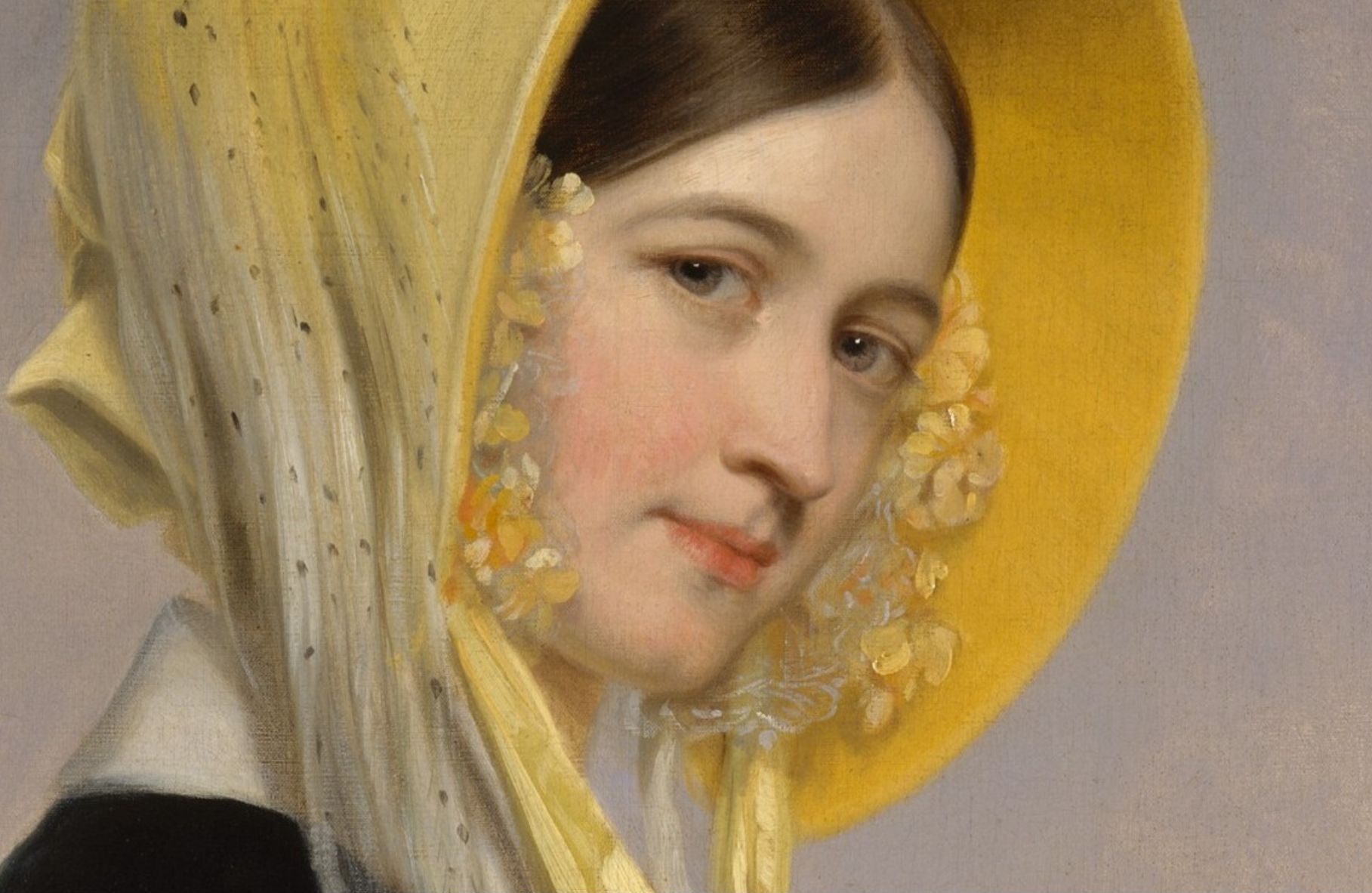
George P. A. Healy | Euphemia White Van Rensselaer, 1842

Euphemia Van Rensselaer (1816-1888) was the daughter of Stephen Van Rensselaer and the sister of Alexander Van Rensselaer.
She was born in Rensselaerswyck, near Albany, New York, and inherited a portion of her father's vast estate in 1839.
This picture was painted in 1842, the year before her marriage to John Church Cruger, a prominent lawyer with whom she settled on Cruger's Island near Barrytown, New York.

George Peter Alexander Healy | Euphemia White Van Rensselaer, 1842 (detail) | Metropolitan Museum of Art

George Peter Alexander Healy (American, 1813-1894) painted the portrait in Paris, where he executed works for visiting Americans as well as for the French king, Louis Philippe.
He blends both lavish detail and texture with a sensitive portrayal of character before a setting suggestive of the Roman campagna from which the sitter had just returned.
The portrait, which shows the influence of the German-born painter Franz Xavier Winterhalter, demonstrates a stunning simplicity, grace, and vivacity rarely equalled in Healy's oeuvre. | Source: © The Metropolitan Museum of Art

George Peter Alexander Healy | Portrait of the Artist, 1851 | Metropolitan Museum of Art

George Peter Alexander Healy | Euphemia White Van Rensselaer, 1842 | Metropolitan Museum of Art


Euphemia Van Rensselaer (1816-1888) era figlia di Stephen Van Rensselaer e sorella di Alexander Van Rensselaer.
Lei nacque a Rensselaerswyck, vicino ad Albany, New York, ed ereditò una parte della vasta proprietà di suo padre nel 1839.
Questo quadro fu dipinto nel 1842, l'anno prima del suo matrimonio con John Church Cruger, un importante avvocato con il quale si stabilì sull'isola di Cruger vicino a Barrytown, New York.

George Peter Alexander Healy | Euphemia White Van Rensselaer, 1842 (detail) | Metropolitan Museum of Art

Il pittore Americano George Peter Alexander Healy (1813-1894) dipinse il ritratto a Parigi, dove eseguì opere per gli americani in visita e per il re francese Luigi Filippo.
Unisce dettagli e texture sontuosi con una rappresentazione sensibile del personaggio davanti a un'ambientazione suggestiva della campagna romana da cui il soggetto era appena tornato.
Il ritratto, che mostra l'influenza del pittore di origine tedesca Franz Xavier Winterhalter, dimostra una straordinaria semplicità, grazia e vivacità raramente eguagliate nell'opera di Healy. | Fonte: © The Metropolitan Museum of Art

George Peter Alexander Healy | Vinnie Ream in ciociara costume, 1870 | Smithsonian American Art Museum

George Peter Alexander Healy | Jennie Byrd Bryan, 1874

George Peter Alexander Healy | Abraham Lincoln

George Peter Alexander Healy | The Peacemakers, 1868 | White House, Washington D.C.